
Energy bills are on every homeowner’s mind in 2026. As utility costs continue to rise, the question of whether your kitchen appliances are working efficiently—or quietly draining your budget—has never been more relevant. For gas cooktop owners, the good news is that natural gas cooking remains one of the most cost-effective ways to cook, and a few simple habits can make it even more efficient.
In this guide, we’ll compare the real energy costs of gas versus electric cooking in 2026, explain how GASLAND’s blue flame technology maximizes combustion efficiency, and give you five practical, actionable ways to lower your kitchen energy bills starting today.
⚡ Gas vs. Electric Cooking Cost in 2026: The Real Numbers
The energy cost comparison between gas and electric cooking starts with a fundamental difference in how energy is priced and delivered. Natural gas is measured in therms (1 therm = 100,000 BTU). Electricity is measured in kilowatt-hours (1 kWh = 3,412 BTU). To compare them fairly, we need to convert both to a common unit.
| Energy Source | Avg. 2026 Cost | Cost per 100,000 BTU | Appliance Efficiency | Effective Cost per 100K BTU |
|---|---|---|---|---|
| Natural Gas | ~$1.20/therm | $1.20 | ~40% (open burner) | ~$3.00 |
| Electric Resistance | ~$0.15/kWh | $4.40 | ~74% (coil/radiant) | ~$5.95 |
| Electric Induction | ~$0.15/kWh | $4.40 | ~84% (induction) | ~$5.24 |
Note: Appliance efficiency figures reflect heat transferred to cookware. Gas burner efficiency varies significantly based on burner design, cookware match, and flame condition. Local utility rates vary—check your utility bills for accurate local pricing.
Even accounting for the lower thermal efficiency of open gas burners, natural gas cooking costs significantly less per cooking session than electric alternatives in most U.S. markets. The raw energy cost advantage of gas is substantial enough to offset the efficiency gap in most household cooking scenarios.
For a deeper comparison of gas and electric cooking across performance, cost, and lifestyle factors, see our Gas vs. Electric Cooktop guide.
🔵 Tip 1: Understand Blue Flame Technology—and Why It Matters for Efficiency

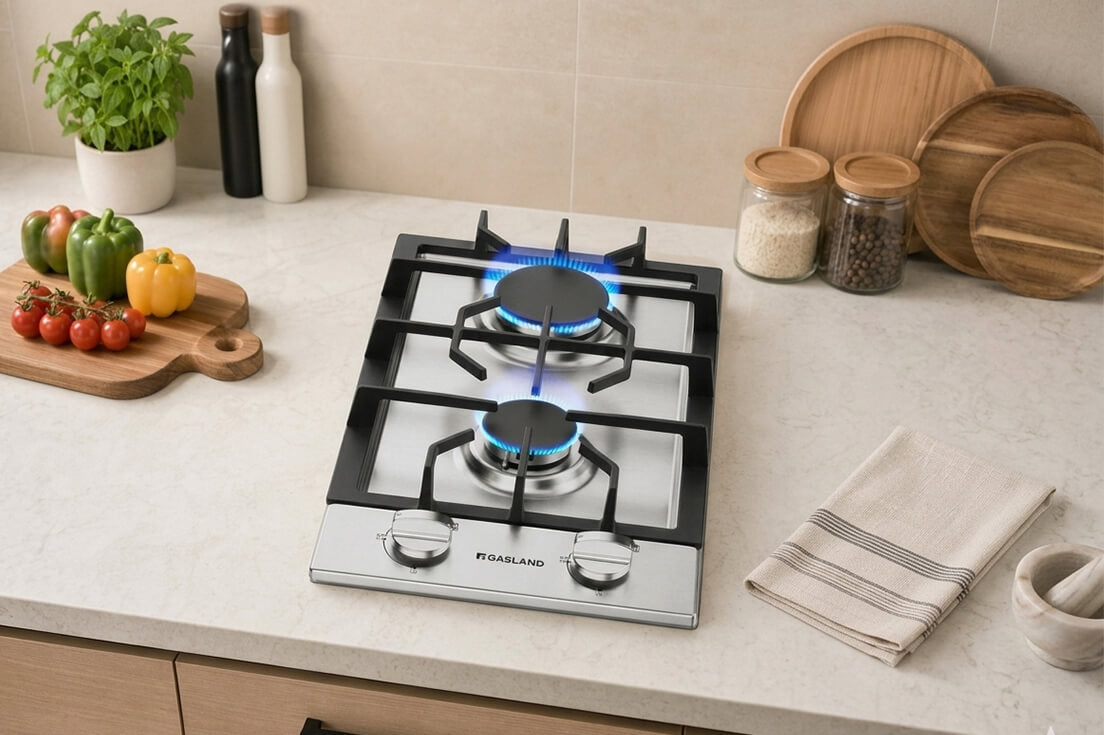
The color of your gas flame is a direct indicator of combustion efficiency. A blue flame means complete combustion: every molecule of natural gas (methane, CH₄) is reacting fully with oxygen to produce heat, carbon dioxide, and water vapor. No fuel is wasted. No carbon monoxide is produced. Maximum heat output per unit of gas consumed.
A yellow or orange flame means incomplete combustion: some gas molecules are not fully reacting, producing carbon monoxide and soot instead of heat. This wastes fuel—you’re paying for gas that isn’t being converted to cooking heat.
GASLAND’s sealed burner design and precision-machined burner ports are engineered to maintain the correct gas-to-air ratio for complete combustion at every flame setting—from the lowest simmer to full power. The result is a consistently blue flame that maximizes the heat energy extracted from every cubic foot of gas.
How to Maintain Blue Flame Performance
- ✅ Keep burner ports clean—clogged ports disrupt the gas-to-air mixture and cause yellow flames
- ✅ Ensure burner caps are correctly aligned after cleaning—misalignment disrupts flame geometry
- ✅ Check that the pressure regulator is correctly installed (arrow pointing toward the cooktop)
- ✅ If flames are consistently yellow, have the gas pressure checked by a licensed technician
🍳 Tip 2: Match Cookware Size to Burner Size
This is the single most impactful efficiency habit most home cooks overlook. When you use a small pan on a large burner, the flame extends beyond the pan base and heats the surrounding air rather than the cookware. This wasted heat can represent 20–30% of the burner’s total output—energy you’re paying for but not cooking with.
The Cookware Matching Rule
- The pan diameter should be within 1 inch of the burner diameter
- Use the simmer burner (lowest BTU) for small saucepans and milk pots
- Use medium burners for standard 10"–12" skillets and saucepans
- Reserve the power burner for large stockpots, woks, and high-heat searing—where its full output is actually needed
- Use flat-bottomed cookware—warped or rounded bottoms create air gaps that reduce heat transfer efficiency
Lid Usage: The Overlooked Efficiency Multiplier
Cooking with a lid on reduces cooking time by 20–40% for boiling and braising tasks. The lid traps steam and heat inside the pot, raising the internal temperature faster and maintaining it with less energy. For every minute you cook with a lid instead of without, you’re reducing gas consumption proportionally.
🔧 Tip 3: Clean Burners Regularly to Maintain Peak Efficiency
A dirty burner is an inefficient burner. Food debris, grease deposits, and mineral buildup in the burner ports restrict gas flow and disrupt the gas-to-air mixture. The result: incomplete combustion, yellow flames, and reduced heat output—meaning you need to run the burner longer (and use more gas) to achieve the same cooking result.
Efficiency-Focused Cleaning Schedule
- After every use: Wipe the burner cap and surrounding area with a damp cloth while still warm (not hot) to prevent food from baking on
- Weekly: Remove burner caps and clean with warm soapy water; use a toothpick to clear individual port holes
- Monthly: Full burner disassembly—soak caps in warm soapy water for 20 minutes, scrub with a soft brush, rinse thoroughly, and dry completely before reassembly
A clean burner produces a consistent blue flame at every setting, maximizing the heat energy extracted from each unit of gas. For a complete cleaning protocol, see our guide on how to clean gas cooktop burners properly.
⏱️ Tip 4: Use the Right Flame Level for the Task
Running a burner at full power when the recipe calls for medium heat is one of the most common—and most wasteful—cooking habits. Gas cooktops are uniquely responsive: the flame adjusts instantly to any setting, and cooking at the correct level for the task uses only the gas actually needed.
Flame Level Guide by Cooking Task
| Cooking Task | Recommended Flame | Why |
|---|---|---|
| Melting chocolate / hollandaise | Simmer (lowest) | Prevents scorching; minimal heat needed |
| Simmering soups / sauces | Low–Medium Low | Maintains gentle bubble without boiling |
| Sautéing vegetables | Medium | Sufficient for browning without burning |
| Boiling water (large pot) | High (then reduce) | High to reach boil; reduce once boiling |
| Searing steak / wok cooking | Power Burner / High | Maximum heat required for Maillard reaction |
| Keeping food warm | Simmer (lowest) | Minimal energy to maintain temperature |
The key insight: reduce the flame once the target temperature is reached. Bringing a pot of water to a boil on high, then reducing to medium-low to maintain the boil, uses significantly less gas than running the burner at high throughout the cooking process.
💡 Tip 5: Choose an Energy-Efficient Gas Cooktop
Not all gas cooktops are equally efficient. The design of the burner system—port geometry, gas-to-air mixing, burner cap material, and sealed vs. open burner construction—significantly affects how much of the gas you pay for is actually converted to cooking heat.
What to Look for in an Energy-Efficient Gas Cooktop
- ✅ Sealed burners—prevent food debris from entering the burner system, maintaining consistent gas-to-air ratios over time
- ✅ Precision-machined burner ports—uniform port geometry ensures even flame distribution and complete combustion
- ✅ Multiple BTU levels—a range from 4,000 BTU (simmer) to 13,000+ BTU (power) allows you to match heat output precisely to the cooking task
- ✅ Brass burner construction—brass maintains port geometry over years of use, unlike aluminum burners that can deform and disrupt flame patterns
- ✅ Flame failure device (FFD)—automatically cuts gas if a flame is extinguished, preventing gas waste from accidental flame-outs
The GASLAND Chef Collection GH4305SF incorporates all of these features: sealed Sabaf brass burners, precision-machined ports, a 4,500–21,000 BTU range across five burners, and FFD on every burner. It’s engineered to extract maximum cooking performance from every unit of gas consumed.
For a comprehensive guide to selecting the most efficient model for your kitchen, see our Best Gas Stoves guide and our dedicated Energy Saving Tips for Gas Cooktops article.
🌱 Is Gas Cooking Eco-Friendly?
The environmental picture for gas cooking is nuanced. Natural gas cooktops with complete combustion (blue flame) produce lower direct carbon emissions per cooking session than electric cooktops powered by coal or natural gas electricity generation—because electricity generation and transmission involve significant energy losses before the power reaches your cooktop.
However, in regions with high renewable electricity penetration (solar, wind, hydro), electric induction cooktops may have lower lifecycle carbon emissions. The environmental comparison is genuinely location-dependent.
What is clear: a gas cooktop that burns completely (blue flame, clean burners, correct cookware matching) minimizes both fuel consumption and emissions per cooking session—making it the most environmentally responsible way to cook with gas.
Frequently Asked Questions
Is gas cooking cheaper than electric in 2026?
In most U.S. regions, yes. Natural gas costs approximately $1.20 per therm (100,000 BTU), while electricity costs approximately $0.15 per kWh (3,412 BTU)—making gas roughly 3–4 times cheaper per unit of heat energy. Even accounting for gas burner efficiency, gas vs electric cooking cost favors gas in most markets.
What is blue flame technology in gas cooktops?
Blue flame indicates complete combustion—all gas molecules are fully reacting with oxygen to produce heat. This maximizes heat output per unit of gas consumed. Yellow or orange flames indicate incomplete combustion, which wastes fuel and produces carbon monoxide. An energy efficient gas cooktop maintains blue flame at all settings.
How does cookware size affect gas cooktop efficiency?
Using a pan that is too small for the burner allows flame to extend beyond the pan base, wasting 20–30% of the burner’s heat output. Match pan diameter to within 1 inch of the burner diameter for maximum efficiency.
How does burner cleaning affect gas cooktop efficiency?
Clogged burner ports disrupt the gas-to-air mixture, causing incomplete combustion and yellow flames that waste fuel. Regular cleaning maintains complete combustion and peak thermal efficiency—a key factor in eco-friendly kitchen appliances performance.
Are gas cooktops eco-friendly?
Gas cooktops with complete combustion (blue flame) minimize fuel waste and direct emissions per cooking session. The environmental comparison with electric depends on your local electricity grid’s energy mix. In most U.S. markets, natural gas efficiency makes gas cooking competitive with or better than grid-powered electric cooking on a carbon basis.
⚡ Lower Your Bills—Starting with Your Next Meal
The five tips in this guide—understanding blue flame combustion, matching cookware to burner size, cleaning burners regularly, using the right flame level, and choosing an efficient cooktop—are all actionable today. Together, they can meaningfully reduce your kitchen gas consumption without changing what you cook or how you cook it.
For more energy-saving strategies, explore our complete Energy Saving Tips for Gas Cooktops guide, and discover the best gas stoves 2026 has to offer for efficiency-focused home cooks.